In today’s competitive printing market, delivering high-quality prints is no longer enough. Customers expect excellent color accuracy, sharp detail, and reliable service as standard. To truly stand out, print service providers need to offer something that goes beyond the ordinary—and that’s where special effects come into play.
From metallic finishes and textured surfaces to white, clear, and neon inks, large format printers now have more opportunities than ever to create eye-catching graphics that add value and leave a lasting impression. By combining innovative printing techniques with creative post-production embellishments, businesses can transform standard prints into premium products that attract new clients and strengthen customer loyalty.
Create More Impact with Specialty Media
One of the easiest ways to elevate large format prints is by selecting unique printing materials. Metallic vinyl, aluminum composite panels like Dibond, textured vinyl, canvas, and faux leather all give printed graphics a distinctive appearance that standard substrates simply cannot match.
Lenticular media also offers exciting possibilities, allowing prints to display different images depending on the viewing angle or even create a three-dimensional illusion, making promotional graphics far more engaging.
After printing, specialty laminates can further enhance the final product. Matte, gloss, frosted, and shimmer laminates not only protect the print but also add premium visual effects that increase its perceived value.
Specialty Inks Open New Creative Possibilities
Beyond substrates, specialty inks provide another powerful way to differentiate printed applications. Although they require printers equipped with additional ink channels and higher operating costs, these inks allow print providers to deliver products that command higher prices and stand out in competitive markets.
However, specialty inks should only be installed when there is consistent demand, as infrequent use can lead to clogged printheads and unnecessary maintenance.
White Ink: More Than Just a Base Layer
White ink remains one of the most valuable specialty inks in large format printing.
Besides printing on transparent or colored materials, it can be used to highlight specific design elements, improve color separation, and enhance image clarity. White ink also makes complex multi-layer graphics possible by separating different image layers.
This capability is especially useful for double-sided window graphics, where different visuals can be viewed from inside and outside a building, as well as backlit displays that require different appearances during the day and at night.
Expand Color with Spot and Neon Inks
Many manufacturers also offer spot colors such as orange, helping expand the printable color gamut and achieve more accurate brand colors, particularly for retail and point-of-sale applications.
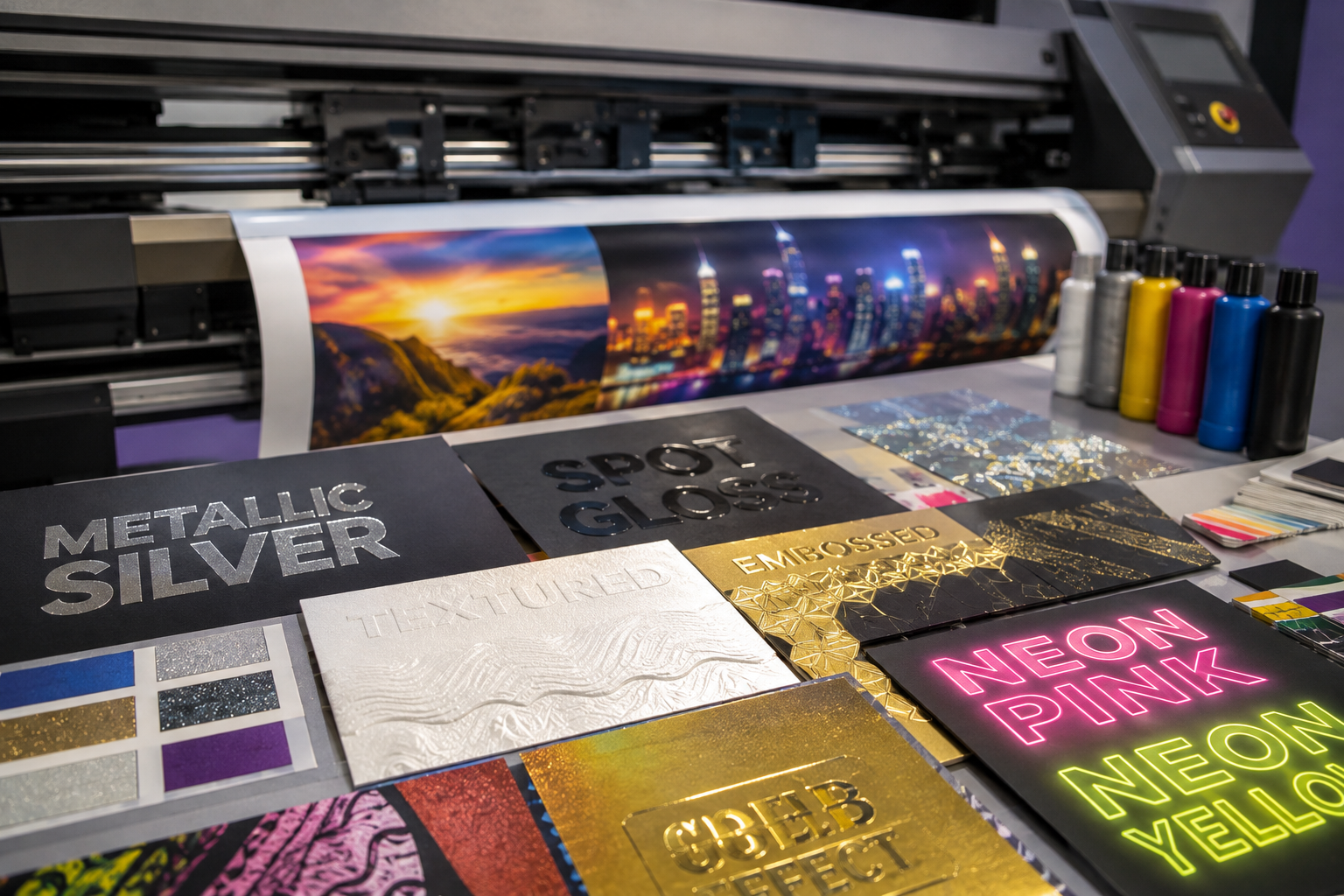
Neon inks have also become increasingly popular. Available in fluorescent yellow and pink, these inks produce vibrant graphics during the day while delivering striking effects under ultraviolet or black light, making them ideal for retail displays, exhibitions, and event graphics.
Metallic and Clear Inks Add Premium Finishes
Although metallic inks are less common today, they continue to offer attractive decorative effects for specialty applications.
Clear ink, often referred to as varnish or gloss, is becoming more widely available. It can be applied as a protective coating or used selectively to create spot gloss effects that highlight logos, text, or specific design elements.
Some manufacturers have developed advanced technologies that produce gloss and matte finishes without additional inks. Solutions like Canon’s FLXfinish and Agfa’s curing technologies allow printers to create striking visual contrasts simply by controlling how the ink is cured.
Adding Texture Creates a New Dimension
UV printing technology also enables the production of textured graphics by printing multiple layers of ink on top of one another.
This technique creates raised surfaces that can simulate embossing, add tactile effects, or produce Braille signage. While multiple printing passes increase production time, the final result offers a premium look and feel that traditional flat printing cannot achieve.
Post-Production Embellishments Increase Print Value
The creative possibilities don’t end once printing is complete.
Modern embellishment systems can add foil, embossing, glitter, metallic finishes, security features, and other decorative effects that dramatically enhance printed products.
At FESPA Global Print Expo, Scodix introduced its Ultra 7000 SHD embellishment press, capable of applying up to seven different polymer-based effects on a single print. Supporting a total of 17 finishing options—including foil, embossing, glitter, metallic, and security effects—the technology enables highly customized, premium-quality graphics for a wide range of applications.
Standing Out Means Offering More Than Print
As customer expectations continue to evolve, offering only high-quality printing is no longer enough.
By investing in specialty media, advanced inks, textured printing, and premium finishing techniques, large format print providers can deliver unique, high-value products that help their customers capture attention and strengthen their brands.
Ultimately, special effects are more than decorative enhancements—they are powerful business tools that create differentiation, increase perceived value, and open new revenue opportunities in an increasingly competitive printing industry.