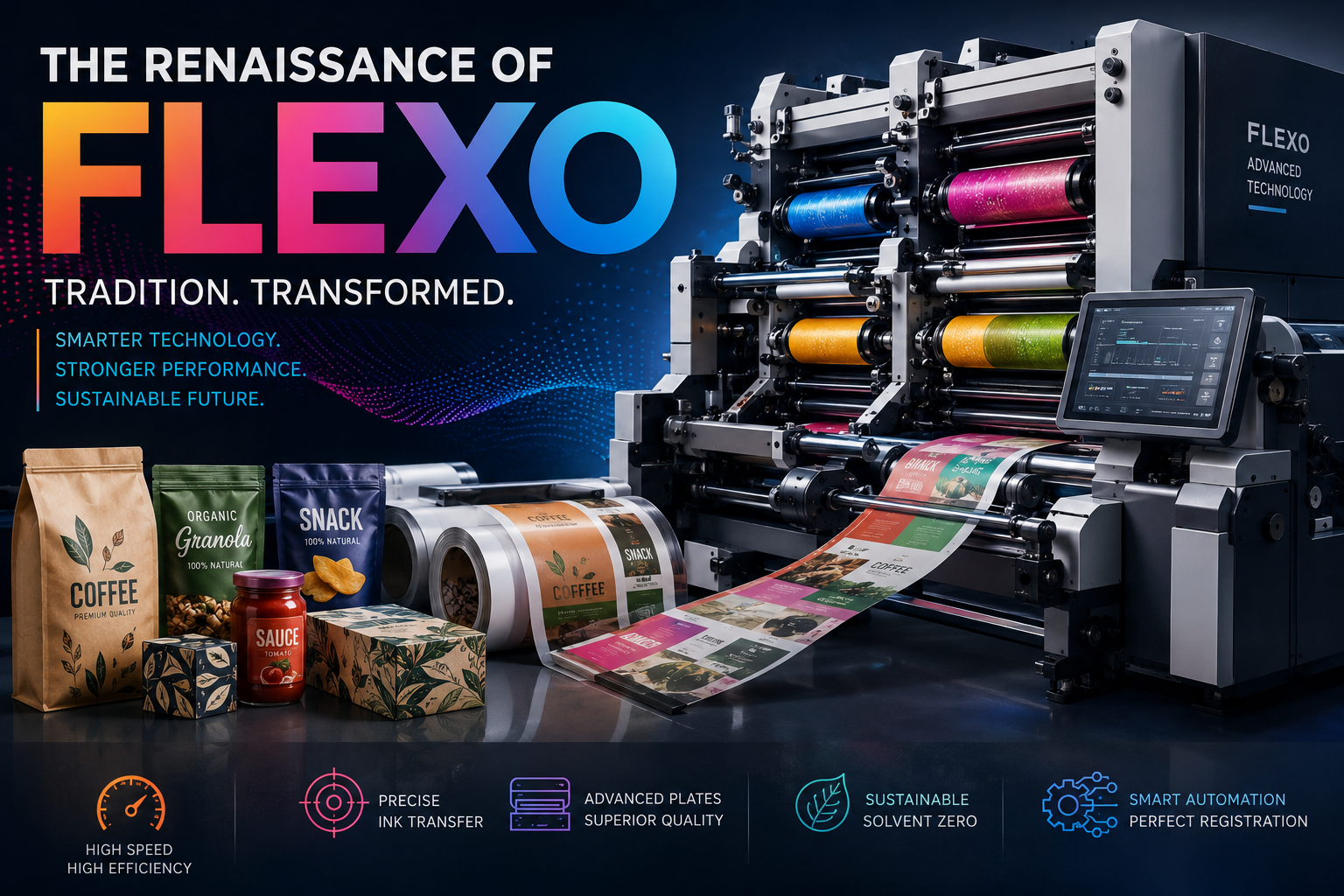
For decades, flexographic printing has been viewed as one of the printing industry’s oldest production methods. Yet in 2026, it is proving that tradition and innovation can go hand in hand. Thanks to major advances in automation, plate technology, ink systems, and digital workflow integration, flexography has evolved into one of the most efficient and cost-effective solutions for packaging production.
While digital printing continues to expand into new markets, flexography remains the preferred choice for high-volume packaging, offering exceptional productivity, outstanding print quality, and unmatched versatility across a wide range of substrates.
A Century-Old Technology Reinvented
Flexography traces its origins back to the late nineteenth century, when it first appeared as aniline printing. During its early years, the technology was largely associated with inexpensive packaging and was often criticized for limited print quality compared to offset and gravure printing.
The introduction of photopolymer printing plates transformed the process completely.
Unlike rigid printing plates, photopolymer plates are flexible enough to adapt to a wide variety of materials, including thin plastic films, paper, labels, flexible packaging, and corrugated board. This flexibility enabled flexography to become the dominant printing technology for the global packaging industry.
Today, it stands alongside offset, gravure, and digital inkjet printing as one of the world’s leading industrial printing technologies.
Why Flexography Continues to Dominate Packaging
Each printing technology serves a different purpose.
Offset printing excels at producing detailed commercial graphics and marketing materials, while gravure remains the preferred option for extremely long production runs.
Digital printing has introduced personalization and variable data capabilities, making it ideal for short runs and customized products.
Flexography occupies the space between them by delivering the best balance of speed, productivity, and cost efficiency for medium- and high-volume packaging production.
Even as digital technologies continue to evolve, flexography remains difficult to match when producing millions of identical packages quickly and economically.
How the Flexographic Printing Process Works
Flexography is based on a rotary relief printing process.
The image is transferred using flexible printing plates with raised image areas that receive ink while the non-printing areas remain recessed.
Liquid ink—whether water-based, solvent-based, or UV-curable—is supplied through an enclosed chamber doctor blade system to an engraved anilox roller. This roller contains thousands of microscopic engraved cells that precisely meter the amount of ink transferred to the printing plate.
The plate then transfers the ink onto the substrate as it passes between the plate cylinder and the impression cylinder.
Maintaining precise ink transfer is essential, ensuring the ink is applied evenly without excessive pressure that could affect print quality. This balance allows the press to produce sharp details, consistent colors, and clean image reproduction even at high production speeds.
Expanding the Color Gamut
Every color in flexographic printing requires its own dedicated printing unit and printing plate.
To reproduce high-quality images, each color layer is printed sequentially as the substrate moves through the press at speeds that often exceed 500 meters per minute.
Maintaining perfect registration at these speeds is critical.
Many modern converters now rely on Extended Color Gamut (ECG) technology, which supplements the traditional CMYK process with orange, green, and violet inks.
This seven-color configuration can reproduce nearly 90 percent of Pantone spot colors, reducing the need for frequent ink changes while increasing production efficiency.
Exceptional Flexibility Across Multiple Substrates
One of flexography’s greatest strengths lies in its ability to print on an extensive range of materials.
Because the flexible printing plates conform easily to uneven surfaces, the technology can produce excellent results on everything from ultra-thin plastic films to heavy corrugated packaging.
This versatility makes flexography the preferred solution for food packaging, labels, flexible packaging, shipping boxes, and many other industrial applications.
In addition to substrate flexibility, the process offers high production speeds, excellent solid color coverage, and low production costs for large-volume jobs.
Understanding the Limitations
Despite its many advantages, flexography does have certain limitations.
Each design requires dedicated printing plates, making very short production runs less economical due to plate manufacturing and setup costs.
Likewise, variable data printing—such as unique QR codes or personalized graphics—is not possible using conventional flexographic plates because the image remains fixed throughout the production run.
Historically, flexography also suffered from ink gain, where printing pressure caused ink to spread beyond the edges of halftone dots, reducing image sharpness.
Automation Is Transforming Press Operations
Modern automation has significantly reduced many of these traditional challenges.
In the past, achieving consistent print quality depended heavily on the experience of press operators.
Today, advanced inspection systems equipped with high-resolution line-scan cameras continuously monitor print quality throughout production.
Operating within closed-loop control systems, intelligent software instantly detects registration errors caused by substrate movement, temperature changes, or web tension.
Instead of relying on manual adjustments, precision servo motors automatically correct these deviations in real time, ensuring precise ink transfer, perfect registration, and consistent print quality throughout the entire production run.
Smarter Printing Plates Deliver Better Quality
Material science has also played a major role in improving flexographic printing.
Modern photopolymer plates feature digitally engineered micro-textured surfaces that control ink transfer far more precisely than previous generations.
These microscopic surface structures prevent ink from spreading beyond the intended image area, producing sharper details and significantly improving print quality.
As a result, today’s flexographic output can rival the quality traditionally associated with offset and gravure printing.
A More Sustainable Printing Process
Sustainability has become another major driver of innovation within flexography.
Traditional plate production relied heavily on chemical solvents to remove unexposed photopolymer, generating volatile organic compound (VOC) emissions and requiring energy-intensive drying processes.
Today, the industry is rapidly embracing Solvent ZERO technologies.
Water-washable photopolymer plates can be processed using ordinary water that is filtered and recycled within closed systems.
Besides reducing environmental impact, these plates require significantly shorter drying times, enabling faster production while lowering operating costs.
The Future of High-Volume Packaging Production
Rather than being replaced by digital printing, flexography has evolved alongside it.
Many modern production facilities now combine digital and flexographic technologies within hybrid workflows, allowing each process to be used where it performs best.
Digital printing handles personalized and short-run jobs, while highly automated flexographic presses continue to deliver unmatched efficiency for long-run packaging production.
With advanced automation, expanded color capabilities, improved plate technology, sustainable manufacturing processes, and precise ink transfer that ensures exceptional print consistency, flexography has successfully reinvented itself.
Far from being an outdated printing method, it remains one of the most advanced, productive, and reliable technologies driving the global packaging industry in 2026.